
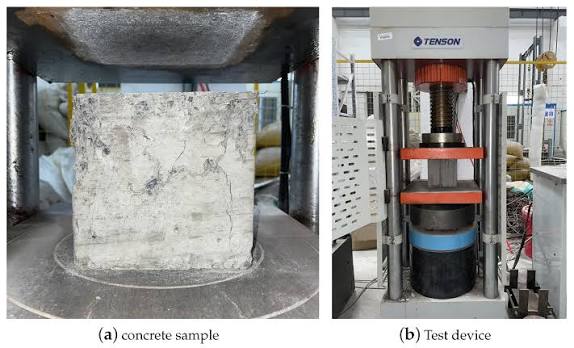
A Glass Reinforced Concrete panel can look perfect and still fail. The surface is smooth, the edges are sharp, the color matches. But if the mix was off, the fibers clumped, or the curing went wrong, the panel will not carry the load it was designed for. The only way to know is to test it.
Strength testing is not just a box to tick for the client or the inspector. It is the only proof that the material behaves the way the design assumes. Facade panels, cladding, benches, planters, and stair treads all rely on the same basic promise: the GFRC will hold together under load, weather, and time.
There is also a practical side. Testing catches problems early, when they are cheap to fix. A batch that fails a flexural test in the workshop costs a few hours. The same batch installed on a building costs weeks and a lot of money. That is why testing is built into production, not bolted on at the end.
This article covers the main strength tests used on GFRC: flexural, tensile, compressive, impact, and bond strength. It explains how samples are prepared, what the results mean, which standards apply, and the mistakes that make test results useless. If you want to understand what is being tested in the first place, this guide on GFRC panels and their properties explains how the material is put together and where it is used.
What Strength Means in Glass Reinforced Concrete
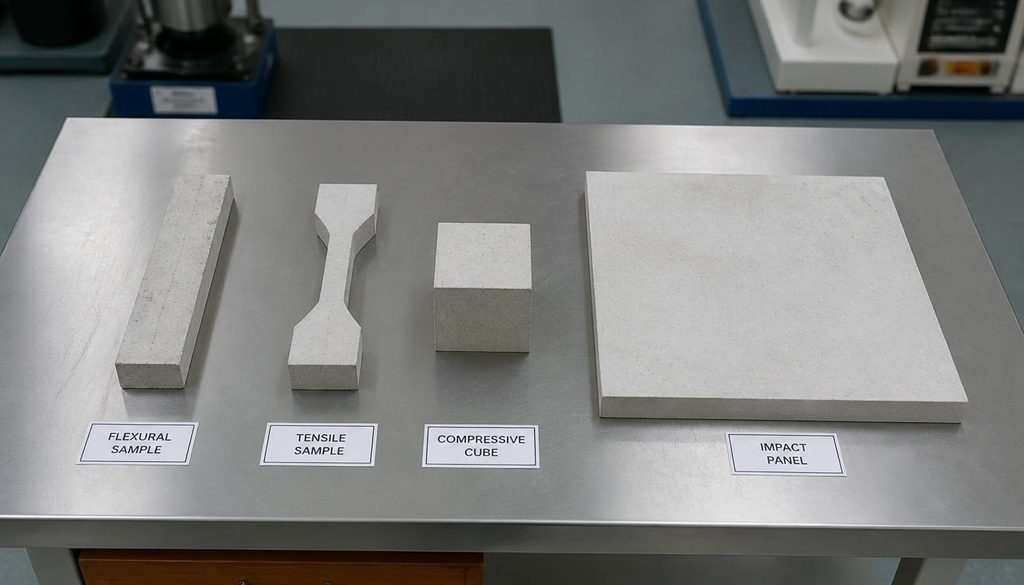
Strong is not one number. GFRC has several strengths. Each one measures something different. A panel can be strong in one way and weak in another. Knowing which strength matters for a project is the first step in testing.
Compressive strength
This is how much the material resists being squeezed. Concrete is naturally good at this. GFRC is no exception. Compressive strength is measured in MPa. It usually ranges from 40 to 80 MPa. It matters for columns and load-bearing elements. However, for thin panels and cladding, it is rarely the critical number.
Flexural strength
This is the key number for GFRC. Flexural strength is how much the material resists bending before it cracks. GFRC is used in thin sections, often 10 to 15 mm. Because of this, bending is the main stress it faces. Wind loads, handling, and installation all bend panels. Flexural strength is measured in MPa. It is tested with a three-point or four-point bending setup. Most specifications quote this number.
Tensile strength
This is how much the material resists being pulled apart. Plain concrete is weak here. The glass fibers give GFRC its tensile strength. Tensile strength is harder to measure directly than flexural strength. Because of this, it is often calculated from flexural test results. It can also be measured with a splitting test. It matters for anchors and connections.
Impact resistance
This is how much energy the material absorbs before it breaks. Impact resistance matters for panels that might be hit during transport. It also matters for elements in public spaces. A bench that cracks when someone jumps on it has poor impact resistance. A panel that survives a dropped tool has good impact resistance. Impact tests use drop weights or pendulum hammers.
Bond strength
This is how well the glass fibers stick to the cement matrix. If the bond is weak, the fibers pull out instead of carrying load. Bond strength also covers coatings and sealers. It is tested with pull-off tests and fiber pull-out tests. Bond strength is not always quoted in specifications. However, it directly affects how the other strengths perform.
Each strength is measured differently. One test does not cover them all. A good testing routine checks the ones that matter for the job.
When to Test: Production vs. Project Testing
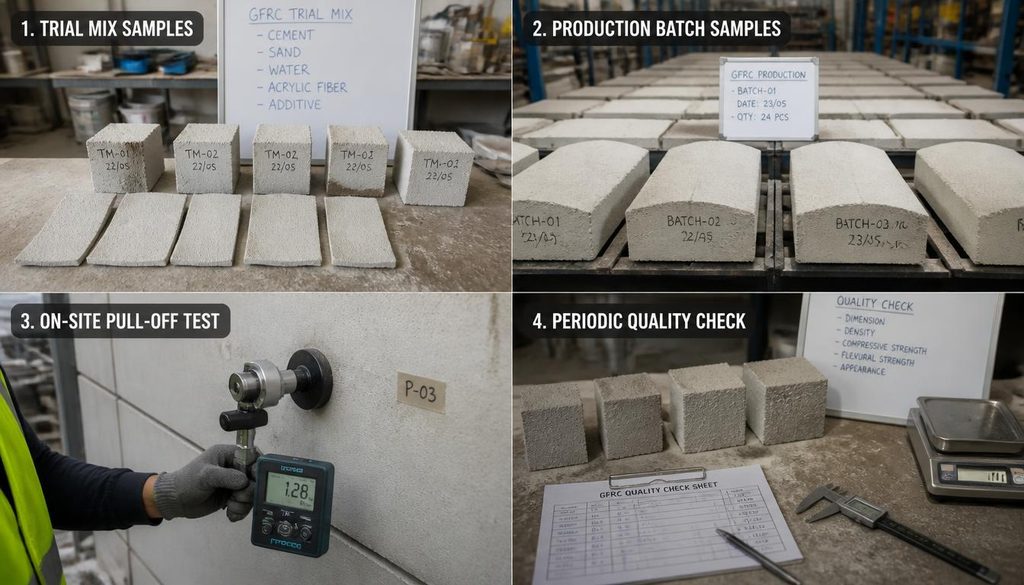
Testing is not one event. It happens at different stages. Some tests check the mix. Others prove the finished product meets the specification. Knowing when to test saves time. It also catches problems before they reach the site.
Trial mixes and prototypes
Before full production, trial mixes are tested. This is where the recipe is checked. Does the mix reach the required flexural strength? Does it flow well? Does it cure without cracking? Trial mixes are small. They are cast into test samples, not full panels. They are cheap and easy to adjust.
Prototypes go one step further. A full-size panel is produced and tested. This catches problems that small samples miss. Warping, surface defects, and handling issues show up here. Prototypes are common on custom projects.
Batch testing during production
Once production starts, batch testing keeps quality steady. Not every batch needs a full test. However, regular sampling catches drift early. A common approach is to cast samples from every batch. These samples are cured and tested alongside the production pieces.
Batch testing checks consistency. If one batch tests lower, something changed. Maybe the sand was wetter. Maybe the fiber content was off. Catching it early keeps weak panels off the site.
On-site verification
Sometimes testing happens after installation. This is common on large projects. The client may also require proof. On-site tests include pull-off tests for coatings. They also include anchor pull-out tests. Core samples from installed panels are another option. These tests confirm the material on the building matches the tested material.
On-site testing is more expensive. It is also harder to control. It is usually reserved for critical projects. It is also used when there is doubt about production quality.
Periodic quality checks
Even on routine production, periodic checks help. This could be monthly or quarterly. It could also be after any change in materials or staff. Periodic testing builds a record. If a problem appears later, the records show when the material was still good.
A good testing routine combines all four. Trial mixes set the baseline. Batch testing maintains it. On-site checks confirm it. Periodic checks document it.
Flexural Strength Testing
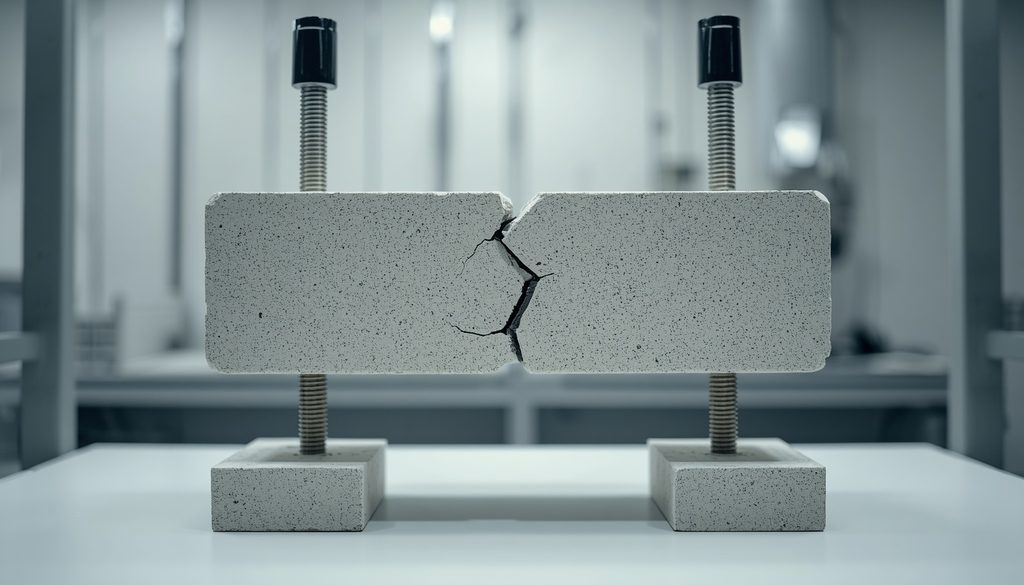
Flexural strength is the number most Glass Reinforced Concrete specs ask for. It measures how much the material resists bending before it cracks or breaks. Since GFRC is used in thin panels, bending is the stress it faces most often.
Why flexural matters most in GFRC
A panel on a facade bends under wind. A bench bends when someone sits on it. A stair tread bends under foot traffic. Compressive strength does not help here. The material needs to resist tension on one side and compression on the other. That is flexural strength. The glass fibers carry the tension. The cement matrix carries the compression. Together they keep the panel from snapping.
Three-point vs. four-point bending
Two test setups are common.
Three-point bending places the sample on two supports and loads it from the top at the center. The sample bends in the middle. The highest stress is at that center point. This test is simple and fast. However, it concentrates stress in one spot, which can cause early failure.
Four-point bending uses two loading points instead of one. The stress is spread across a wider area between the two loads. This gives a more even result. It is also better at showing how the material performs in real use. Most GFRC standards prefer four-point bending.
Sample preparation
The sample size and shape matter. Common sizes are 50 mm wide and 12–15 mm thick, with a span of 150–200 mm. The sample has to match the thickness of the actual product. A thin sample will give a different result than a thick one.
Samples are cast from the same mix as the production pieces. They are cured under the same conditions. If the production panels are cured in a humid room, the samples are too. This keeps the test honest.
Test procedure
The sample is placed on the supports. The loading head moves down at a steady rate, usually 1–2 mm per minute. The load is recorded until the sample cracks or breaks. Some tests stop at first crack. Others continue to measure post-crack behavior. GFRC is designed to carry load after cracking, so post-crack data is often useful.
Reading the results
Flexural strength is calculated from the load at failure. The formula uses the span, the width, and the thickness of the sample. The result is reported in MPa. A typical glass reinforced concrete flexural strength is 18–30 MPa, depending on the mix and fiber content.
Two numbers are often reported: the strength at first crack (LOP) and the strength at ultimate failure (MOR). LOP shows when the matrix cracks. MOR shows when the fibers finally give way. The gap between them tells you how much post-crack performance the material has.
Tensile Strength Testing
Tensile strength is how much the material resists being pulled apart. Plain concrete is weak here. It cracks under very little tension. The glass fibers are what change that. They bridge across cracks and carry the load. Without them, Glass Reinforced Concrete would behave like ordinary concrete.
Direct tensile tests
The most accurate way to measure tensile glass reinforced concrete strength is a direct pull test. A sample is gripped at both ends and pulled until it breaks. The force at failure is divided by the cross-sectional area. The result is reported in MPa.
Direct tensile tests are difficult to run on GFRC. The sample has to be gripped without crushing it. The grips often cause failure at the ends instead of the middle. Because of this, direct tensile testing is rare in routine production. It is mostly used in research.
Splitting tensile tests
A more practical method is the splitting tensile test. A cylinder or cube sample is placed on its side. A compressive load is applied along its length. The sample splits down the middle from the tension that builds up. The force at splitting is used to calculate tensile glass reinforced concrete strength.
This test is easier to set up than a direct pull test. It uses the same compression machine as other tests. The result is not identical to direct tensile strength, but it is close enough for most quality control purposes.
When tensile data is needed
Not every project needs tensile testing. Flexural strength covers most design cases for panels and cladding. However, tensile data matters in a few situations:
- Anchors and connections: The area around an anchor is under tension. Tensile strength tells you how much load the anchor can take.
- Thin sections: Very thin panels rely more on fiber performance. Tensile data shows how well the fibers are working.
- Research and development: New mixes or fiber types are compared using tensile tests.
- Failure analysis: When a panel fails, tensile data helps explain why.
For most production, flexural testing is enough. Tensile testing is used when the application demands it.
Compressive Strength Testing
Compressive glass reinforced concrete strength is how much the material resists being squeezed. Concrete is naturally good at this. GFRC is no exception. However, for thin panels, compressive strength is rarely the critical number. It still matters for columns, load-bearing elements, and anything that carries weight from above.
Cube and cylinder samples
Two sample shapes are common. Cubes are usually 50 mm or 100 mm. Cylinders are often 100 mm diameter and 200 mm tall. Cubes are easier to cast and store. Cylinders give a more uniform result because the shape reduces edge effects. Both are used, but the standards usually specify which one applies.
The sample size affects the result. A 50 mm cube often tests higher than a 100 mm cube from the same mix. This is because smaller samples have fewer internal flaws. For this reason, results are only comparable when the sample size and shape match.
Test equipment
A compression testing machine applies load to the sample until it breaks. The machine has two platens. The sample sits between them. One platen moves down at a steady rate, usually 0.5 to 1 MPa per second. The load at failure is recorded. The result is divided by the cross-sectional area to get compressive strength in MPa.
The machine needs to be calibrated. A machine that reads high or low gives wrong results. Calibration is usually done once a year by an external lab.
What compressive strength does and does not tell you
Compressive glass reinforced concrete strength tells you how the material behaves under direct load. It is useful for columns, foundations, and bearing walls. It does not tell you how the material handles bending, impact, or tension. A mix with high compressive strength can still crack easily under flexural load.
For GFRC, compressive strength is usually a secondary number. Flexural strength is the one that matters most. However, compressive strength is still tested because it is part of the standard and because it gives a baseline for mix consistency.

Emma Clarke is an architect with a background in building materials and facade engineering. She has worked on GRC projects in various climates and specializes in material performance and restoration.