

Every GRC facade panel, every cladding element, every architectural component begins its life with a specification sheet. On that sheet, two values appear more frequently than any others: LOP and MOR. These abbreviations represent far more than technical jargon—they form the foundation upon which safe, durable, and aesthetically successful GRC installations are built. Understanding what these terms mean, how they are measured, and why they matter separates competent designers from those who merely specify materials without comprehending their behavior.
The International Glassfibre Reinforced Concrete Association (GRCA) identifies the flexural strength test—often called the “MOR/LOP test”—as one of the most critical evaluations for GRC products. This bending test reveals how a material responds when forces attempt to deform it, providing essential data for structural calculations. Without accurate LOP and MOR values, engineers cannot confidently determine panel thicknesses, support spacing, or wind load resistance. The consequences of misunderstanding these parameters range from over-engineered, unnecessarily expensive facades to under-designed components that fail prematurely.
Defining LOP: The Limit of Proportionality
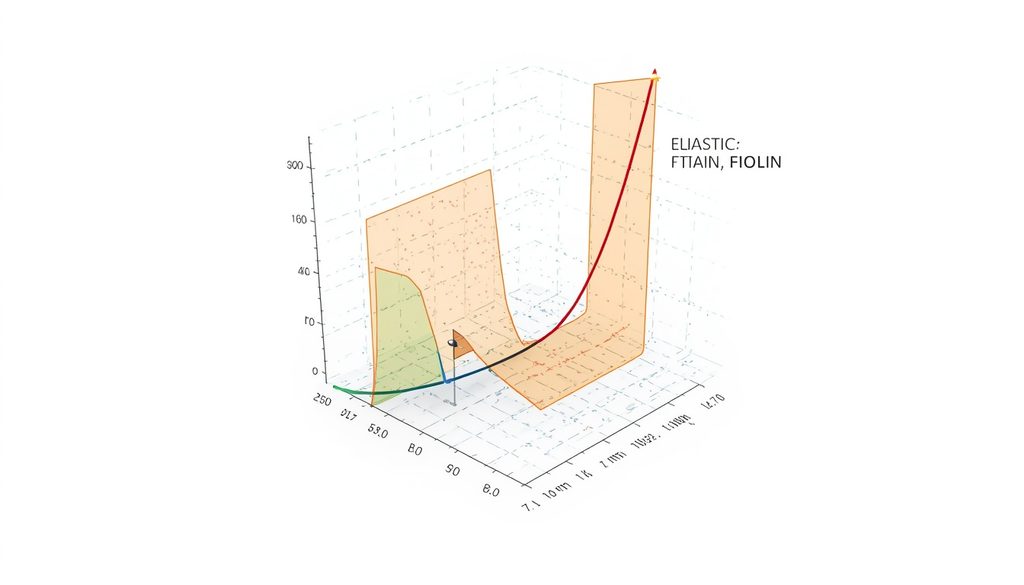
The Limit of Proportionality, frequently shortened to LOP, describes the stress level at which a material’s behavior transitions from elastic to non-linear. In simpler terms, it marks the boundary between reversible and irreversible deformation. When stress remains below the LOP, the material stretches proportionally to the applied load and returns to its original shape upon unloading. Once stress exceeds this threshold, microscopic cracks begin forming within the cementitious matrix, and the material’s response becomes increasingly complex.
GRCA defines LOP as “the stress in a flexural bending test where the stress/strain plot deviates from a straight line”. This deviation signals the onset of matrix cracking. The glass fibers, which had until this point shared load with the cement paste, now must carry greater responsibility. The LOP value therefore represents the upper limit of the material’s purely elastic range.
For designers, LOP serves as a critical safety parameter. Service loads should remain well below this threshold to prevent permanent deformation and crack initiation. Typical LOP values for sprayed GRC range from 8 to 13 MPa, while premix formulations generally exhibit values between 7 and 9 MPa. The GRCA recommends characteristic LOP values of 7 MPa for sprayed GRC and 5 to 6 MPa for poured GRC, levels determined through extensive experience to correspond with quality materials and reliable manufacturing.
Understanding MOR: The Modulus of Rupture
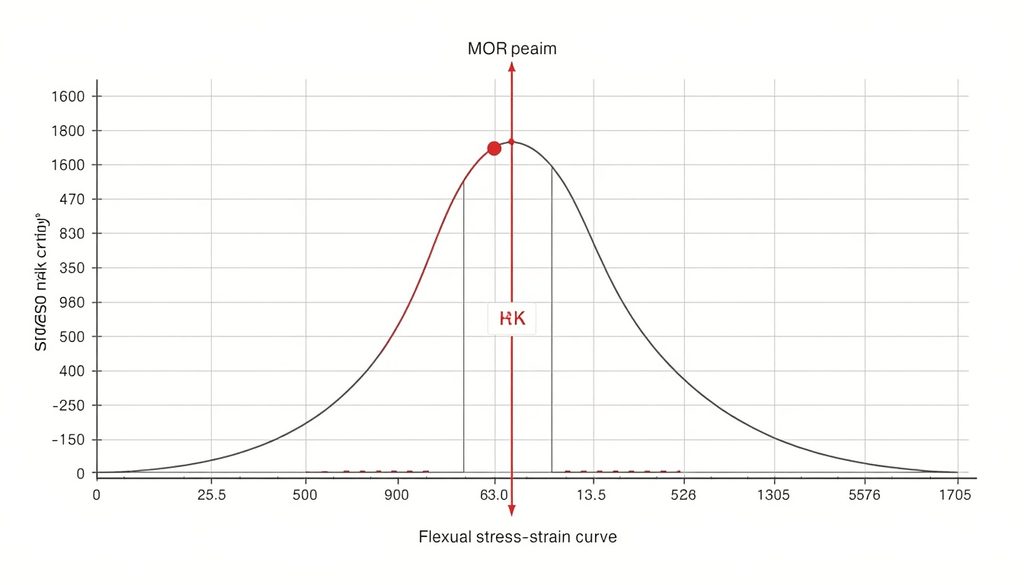
The Modulus of Rupture, abbreviated as MOR, represents the highest stress a material can withstand during a flexural bending test. This value marks the point of complete failure—when the specimen fractures and can no longer carry load. While LOP indicates when damage begins, MOR indicates when structural integrity ends.
MOR values for GRC significantly exceed LOP values, reflecting the reinforcing contribution of glass fibers. Sprayed GRC typically achieves MOR values between 20 and 30 MPa, while premix formulations reach 10 to 14 MPa. The GRCA suggests characteristic MOR values of 18 MPa for sprayed GRC and 8 to 10 MPa for poured GRC as appropriate specification targets.
The relationship between MOR and LOP provides insight into a material’s ductility and toughness. A higher MOR-to-LOP ratio indicates greater post-cracking performance—the ability to sustain loads after initial matrix failure. This property proves especially valuable in applications where impact resistance or seismic performance matters. Synthetic fiber reinforcements often demonstrate superior residual strength compared to glass fibers at equivalent dosages, with residual-to-LOP ratios reaching 61% versus 33% for glass fiber mixes.
Testing Methodology: How LOP and MOR Are Determined

The standard test for determining LOP and MOR involves four-point bending of a simple beam specimen. GRCA guidelines specify samples typically measuring 50mm wide by 10mm thick with a span of 250mm, held in a specialized jig. The four-point configuration ensures uniform bending moment between the two loading points, providing consistent stress distribution across the test region.
ASTM C947-99, the American standard for this test, covers “determination of the modulus of rupture in bending and the flexural proportional elastic limit of glass-fiber reinforced concrete sections by the use of a simple beam of 1.0 in. (25.4 mm) or less in depth using third-point loading”. European standards including BS EN 1170 and BS EN 15191 provide equivalent methodologies for international projects.
During testing, instruments record the applied load and resulting deflection continuously. Software analysis generates a stress-strain curve from which both LOP and MOR are extracted. Young’s modulus for the initial elastic region and strain to failure may also be calculated from the same data. The GRCA recommends minimum testing frequencies of weekly for poured GRC and twice weekly for sprayed GRC, though more frequent testing is common during production startups or when material variations occur.
Factors Influencing LOP and MOR Values
Multiple variables affect the flexural performance of GRC, and understanding these factors helps designers specify appropriate values for their applications.
Fiber Content: Research confirms that LOP and MOR increase with higher fiber content within practical ranges. However, excessive fiber addition can impair workability, leading to less dense matrices and potentially reduced strength. The optimal fiber dosage balances reinforcement benefits against manufacturing considerations.
Fiber Type and Configuration: The dimensional form of glass fiber reinforcement significantly impacts mechanical performance. Three-dimensional glass fiber spacer fabrics achieve LOP values of 15.48 MPa and MOR values of 34.68 MPa—substantially exceeding standard chopped strand performance. Alkali-resistant (AR) glass fibers specifically engineered for cementitious environments maintain their reinforcing capacity better than general-purpose glass compositions.
Matrix Composition: The cementitious matrix formulation plays a decisive role in long-term performance. Research comparing different binder systems found that matrices incorporating calcium sulfoaluminate cement and recycled fine aggregate maintained stable MOR values for up to 85 days, while ordinary Portland cement matrices experienced rapid strength decline. After accelerated aging, alternative matrices retained 50-70% of initial MOR compared to 73% for plain GRC.
Water-to-Cement Ratio: The ratio of water to cementitious materials affects both workability and ultimate strength. Lower ratios generally produce denser, stronger matrices, though practical limits exist for placement and compaction.
Curing Conditions: Proper curing ensures complete hydration of cementitious materials and optimal fiber-matrix bonding. Inadequate curing reduces both LOP and MOR while increasing susceptibility to long-term degradation.
Design Applications: Using LOP and MOR in Practice
Armed with accurate LOP and MOR values, designers can perform the calculations that ensure safe and efficient GRC installations.
Allowable Stress Design: Many codes and standards employ allowable stress principles, applying safety factors to LOP or MOR values. A typical approach divides the characteristic LOP by a safety factor (often 2.0 to 3.0) to determine allowable service stresses. This methodology ensures that working loads remain comfortably within the elastic range, preventing crack initiation under normal conditions.
Ultimate Limit State: For extreme load events such as severe wind gusts or seismic activity, designers may evaluate performance against MOR with appropriate reduction factors. This approach acknowledges that limited cracking may be acceptable provided structural integrity is maintained.
Panel Thickness Determination: Flexural capacity scales with the square of panel thickness. Knowing required moment resistance and material MOR allows calculation of minimum thickness for given support conditions. Conversely, for specified thicknesses, maximum support spacing can be determined.
Deflection Control: While strength often governs design, deflection criteria may control in certain applications. LOP and Young’s modulus values enable prediction of panel deflection under load, ensuring that visual and functional requirements are satisfied.
Quality Assurance and Specification
Specifying GRC without reference to LOP and MOR values leaves performance to chance. Quality specifications should include:
- Required characteristic LOP and MOR values appropriate to the manufacturing process
- Testing frequency and methodology
- Acceptance criteria for production testing
- Procedures for addressing non-conforming results
The GRCA Specification for the Manufacture, Curing & Testing of Glassfibre Reinforced Concrete Products provides comprehensive guidance on these matters, representing accumulated industry experience across decades of GRC applications.
Conclusion: The Foundation of GRC Design
LOP and MOR represent more than laboratory measurements—they embody the fundamental mechanical behavior of glass fiber reinforced concrete. The Limit of Proportionality defines the boundary of elastic response, indicating when permanent changes begin. The Modulus of Rupture establishes ultimate capacity, marking the limit of structural function. Together, these values enable designers to create GRC components that perform reliably across diverse applications and environmental conditions.
As GRC technology continues evolving, with new fiber types, matrix formulations, and manufacturing processes emerging, LOP and MOR testing remains the constant benchmark for quality assessment. Whether specifying panels for a Moscow skyscraper or a museum facade in Istanbul, understanding these principles ensures that architectural ambitions rest on a foundation of sound engineering. The numbers may appear simple on a specification sheet, but their implications extend through every stage of design, fabrication, and installation—ultimately determining whether a GRC facade delivers decades of service or fails prematurely.

Emma Clarke is an architect with a background in building materials and facade engineering. She has worked on GRC projects in various climates and specializes in material performance and restoration.