
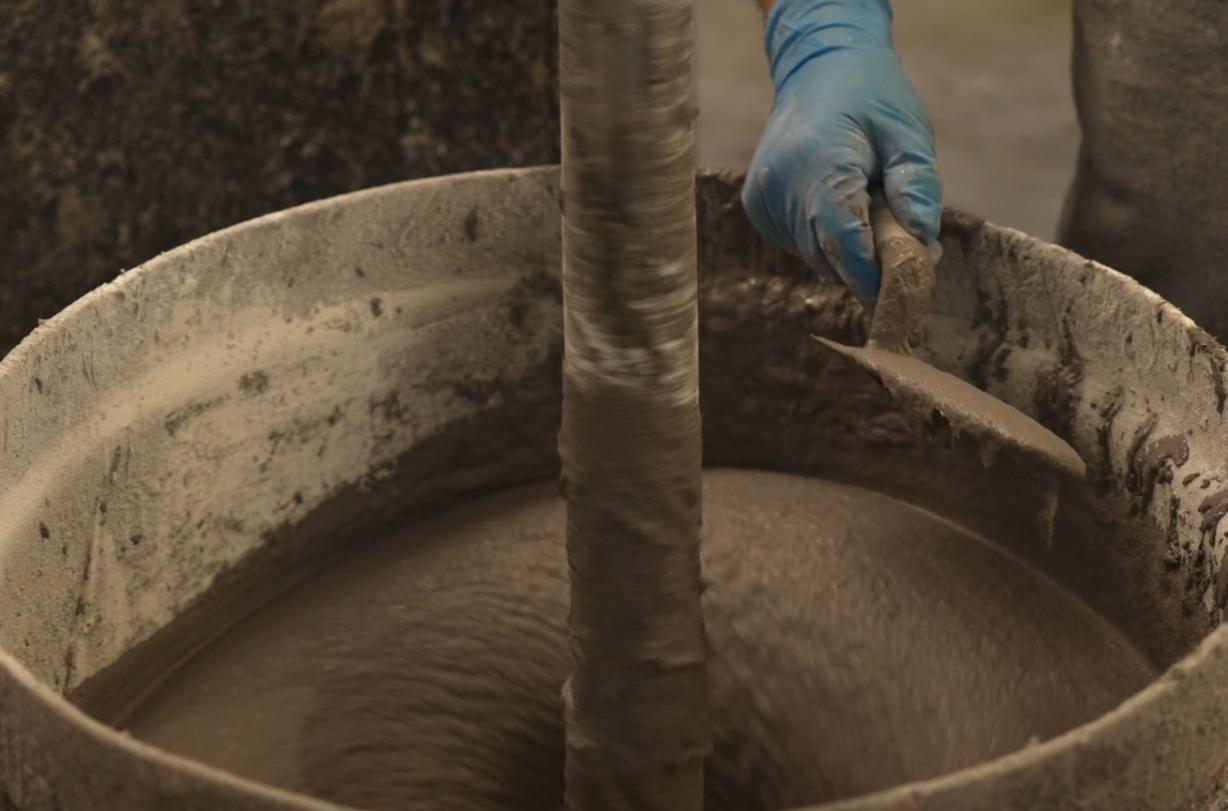
A glass reinforced concrete mix can look fine in the bucket and still fail in the mold. The fibers clump. The surface chalks. The panel cracks three weeks later. Most of the time, the problem started at the mixing stage, not in the mold or the curing room.
Mixing is where the material is decided. The ratios set the strength. The tools control the consistency. The order of ingredients affects how the fibers spread through the mix. Get any of these wrong and the rest of the process cannot fix it. A perfect mold and a skilled spray operator mean nothing if the mix is off.
There is also a practical side. GFRC is not mixed by feel. It is weighed, measured, and timed. Small changes in water content or fiber length change how the mix flows, how it bonds, and how it performs outdoors. That is why the same recipe can produce strong panels in one workshop and weak ones in another.
This article covers the ratios, the tools, and the mistakes that matter most. It also explains how mixing changes between spray-up and premix, how to test a batch before casting, and what to do when a mix goes wrong. If you want to understand how the mix fits into the rest of the production process, this guide on Glass Reinforced Concrete mold making explains what happens before and after the mixing stage.
Understanding the glass reinforced concrete Mix

A GFRC mix is not complicated on paper. It has a few basic ingredients. What makes it work is how those ingredients interact and how carefully they are measured.
What goes into a GFRC mix
There are five main components:
- Cement: The binder. Usually Portland cement, sometimes blended with fly ash, silica fume, or slag.
- Aggregates: Fine silica sand. It gives the mix body and reduces shrinkage.
- Water: Activates the cement. Too much weakens the mix. Too little makes it unworkable.
- Glass fibers: The reinforcement. AR glass, chopped to specific lengths.
- Admixtures: Superplasticizers, polymers, accelerators, and retarders. They control flow, flexibility, and setting time.
Some mixes also include pigments for integral color.
How the ingredients work together
Cement and water form the paste. Sand fills the gaps and adds bulk. Fibers carry tensile stress and stop cracks. Admixtures adjust how the mix behaves before it sets. Change one ingredient and the others need to adjust too. More water means more cement needed to keep strength. More fiber means more superplasticizer to keep the mix workable.
Spray up mix vs. premix mix
These are not the same recipe. Spray-up mix is a rich cement slurry. The fibers are chopped and added at the spray gun, not in the mixer. The mix itself has no fibers in the tank.
Premix mix has fibers already blended into the wet mix. Fiber content is lower because high amounts make the mix stiff and hard to pour. The mix design has to account for that from the start.
The two methods produce different materials. Spray-up gives higher fiber content and stronger panels. Premix is easier to cast into complex shapes. The recipe follows the method, not the other way around.
Glass reinforced concrete Mix Ratios: What the Numbers Mean
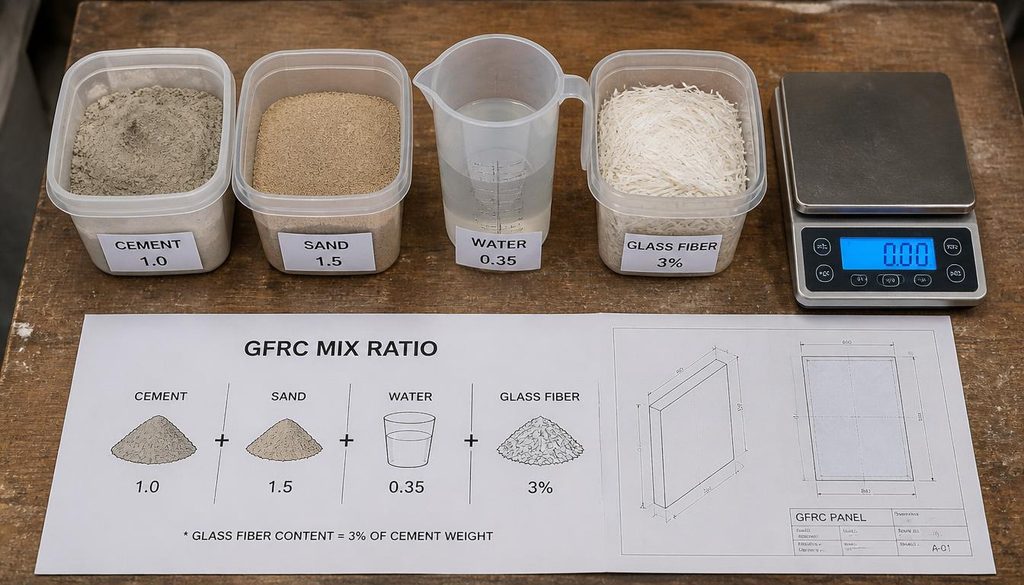
Ratios are where most glass reinforced concrete problems start. A mix that is slightly off can still look fine in the bucket. It only shows its weakness weeks later, when the panel cracks or the surface chalks. Understanding what each ratio controls makes it easier to spot trouble before casting.
Cement to sand ratios
Most GFRC mixes use a cement-to-sand ratio between 1:1 and 1:1.5 by weight. A richer mix (more cement) gives higher strength and a smoother surface. A leaner mix (more sand) costs less and reduces shrinkage, but it is weaker. The right ratio depends on the application. Thin facade panels usually need a richer mix. Bulkier landscape elements can handle more sand.
Water to cement ratios
This is the most important ratio in any concrete mix, and GFRC is no exception. A typical water-to-cement ratio is 0.30 to 0.38. Lower means stronger but harder to work with. Higher means easier to mix but weaker and more prone to shrinkage and cracking.
The trap is that superplasticizers make a dry mix flow like a wet one. That means a mix can look workable while still having a low water content. Judging by eye is not enough. The water has to be weighed.
Fiber content by weight
Fiber content is usually measured as a percentage of the total mix weight. Spray-up GFRC typically uses 4–6% AR glass fibers. Premix GFRC uses 2–3.5%. Below that range, the fibers do not carry enough load. Above it, they clump, tangle, and create weak spots.
The fiber length matters too. Spray-up uses fibers around 12–25 mm. Premix uses shorter fibers, usually 6–12 mm, so they can be mixed into the wet concrete without balling up.
Polymer and admixture amounts
Polymer emulsions are added at 5–10% of the cement weight. They improve flexibility, reduce cracking, and help the material cure in thin sections. Superplasticizers are added in small amounts, usually less than 1% of the cement weight. Too much causes retardation and surface defects. Too little leaves the mix stiff and hard to spray or pour.
How ratios change with method and application
A spray-up mix for a facade panel is not the same as a premix for a planter. Thin panels need higher fiber content and a richer paste. Thick elements can use more sand and less cement. Outdoor pieces need more polymer. Indoor decorative pieces can use less.
There is no single recipe that works for everything. The ratios have to match the method, the shape, and the exposure.
Tools and Equipment for Mixing Glass reinforced concrete

Good glass reinforced concrete comes from good tools. You can have the right recipe and still ruin the batch with a weak mixer or a bad scale. The equipment does not need to be expensive, but it has to be accurate and suited to the method.
Mixers: paddle, pan, and barrel types
The mixer has to handle a stiff, fiber-filled mix without stalling or leaving dry pockets.
- Paddle mixers are handheld or drill-mounted. They work for small batches and premix. They are cheap but slow, and they struggle with high-fiber mixes.
- Pan mixers are the standard for production. They have a rotating pan and fixed blades that fold the mix instead of whipping it. They handle high fiber content without clumping.
- Barrel mixers are used for larger batches. They work for premix but are not ideal for spray-up slurry, which needs a smooth, lump-free consistency.
For spray-up, the mixer feeds a pump and spray gun. The mix has to stay smooth and consistent from the first spray to the last.
Scales and measuring tools
GFRC is weighed, not scooped. A digital scale accurate to 0.1 kg is the minimum. For small batches, a scale accurate to 10 grams is better. Water is weighed too, not measured by volume. Admixtures are often measured in grams.
Volume measuring causes variation. A cup of sand is not the same weight every time. A scale removes that guesswork.
Spray guns and pumps
In spray-up glass reinforced concrete, the pump moves the cement slurry to the gun, where it meets the chopped glass fibers. The gun has a chopper that cuts the roving to the set length. The pump has to deliver a steady flow at the right pressure. If the pressure drops, the mix sputters and the fiber content changes.
Premix does not use a spray gun. It is poured or pumped into molds directly. The equipment is simpler, but the mixer has to handle the fibers without breaking them.
Buckets, hoses, and flow control
Buckets need to be clean and free of dried concrete. Hoses have to be the right diameter for the pump and mix consistency. Flow control valves let the operator adjust the output without changing the mix. Dirty or worn equipment causes inconsistent batches and surface defects.
Safety gear: masks, gloves, eye protection
Glass fibers irritate skin and lungs. Cement is alkaline and burns. Silica dust is a health hazard. Anyone mixing GFRC needs:
- Nitrile or rubber gloves
- Dust mask or respirator
- Safety glasses or goggles
- Long sleeves and trousers
- Boots with good grip
Ventilation matters too. Mixing indoors without airflow lets dust and fibers build up in the air.
Mixing glass reinforced concrete: The Order That Works
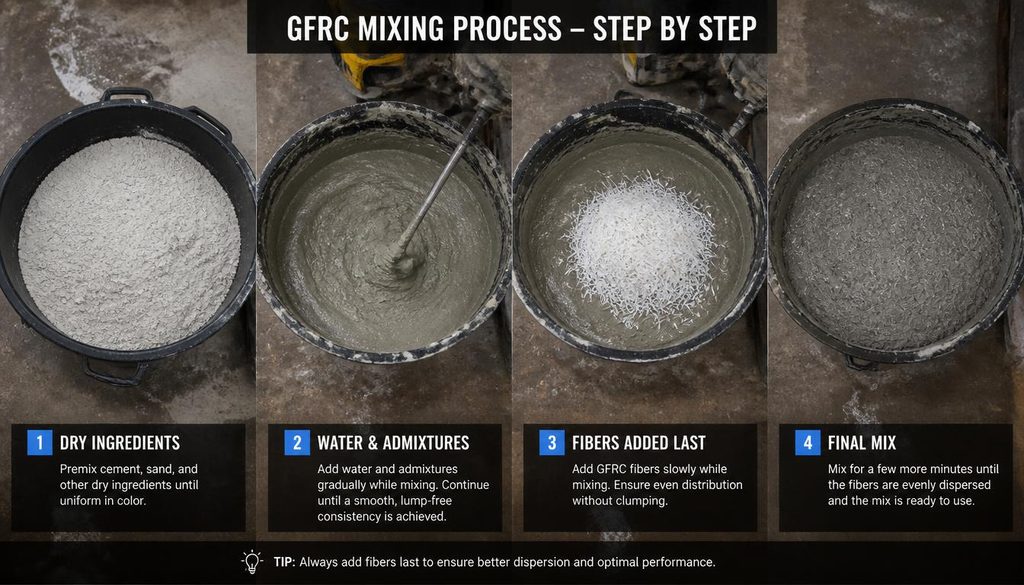
Mixing glass reinforced concrete is not about throwing everything into a bucket and hoping for the best. The order matters. Add fibers too early and they clump. Add water too fast and the mix seizes. Skip a step and the batch is inconsistent from one corner of the mold to the next.
Here is how it actually works in a workshop.
Preparing the workspace
Before anything is weighed, the mixer, buckets, and tools need to be clean. Dried concrete from the last batch will not break down in the new mix. It stays as hard chunks that show up as defects in the final panel. The scale needs to be zeroed. The water needs to be measured. The fibers need to be within reach but not open to the air longer than necessary.
Weighing dry ingredients
Cement and sand go onto the scale first. They are weighed separately and then combined in the mixer. Some workshops pre-blend dry ingredients in a separate drum to save time. Either way, the weights have to match the recipe. A handful more sand changes the strength. A handful less cement changes the surface.
Adding water and admixtures
Water goes in next, but not all at once. Most of the water is added first, then the superplasticizer, then the rest of the water slowly until the mix reaches the right consistency. Polymer emulsion is usually added with the water. Accelerators or retarders go in last, after the mix is already flowing. Adding them too early causes setting problems before the batch is even poured.
Introducing glass fibers
This is where the method matters.
For spray-up, the fibers are not added to the mixer at all. The slurry is pumped to the gun, and the fibers are chopped and added at the nozzle. The mixer only handles the cement paste.
For premix, fibers go into the wet mix after the paste is smooth. They are added slowly, with the mixer running at low speed. Dumping them in all at once causes balling. The fibers need to be sprinkled in and folded, not whipped.
Mixing time and speed
Premix needs about 1–2 minutes of low-speed mixing after the fibers go in. More than that breaks the fibers and reduces strength. Less than that leaves dry pockets.
Spray-up slurry needs longer mixing before it goes to the gun, usually 3–5 minutes, but no fibers are involved at that stage. The slurry has to be completely smooth before spraying starts.
Checking consistency before casting
Before the mix goes into a mold or a spray gun, it needs a quick check. Does it flow without being watery? Are there lumps? Do the fibers look evenly spread or are they clumped? A simple slump or flow test gives a number, but a trained eye can catch most problems before they reach the mold.
A batch that looks wrong usually is wrong. Starting over costs less than casting a panel that fails later.

Emma Clarke is an architect with a background in building materials and facade engineering. She has worked on GRC projects in various climates and specializes in material performance and restoration.