
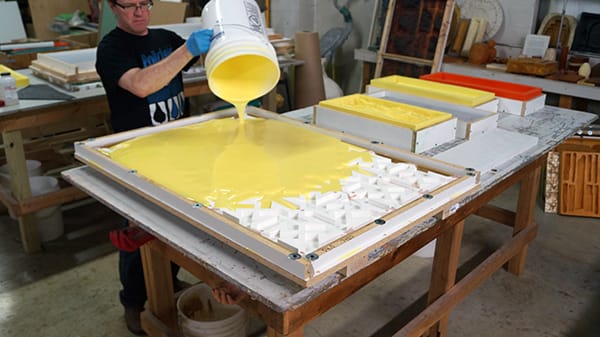
Every Glass Reinforced Concrete piece starts with a mold. The mold decides the shape, the surface texture, and the level of detail. It also decides how many times you can reproduce the same piece before the mold wears out or breaks.
A good mold makes production smooth. It releases cleanly, holds its shape, and transfers a sharp surface to the concrete. A bad mold causes sticking, warping, air bubbles, and surface defects. It costs time and money, and sometimes it ruins the piece entirely.
Mold making is not the same for every project. A single decorative panel needs a different mold than a thousand identical planters. A flat tile is simpler than a curved bench with undercuts. The same logic applies to how GFRC elements are handled after casting—installation methods change with panel size, weight, and shape, just as mold design does. You can see how these decisions play out on site in this overview of GRC cladding installation.
This article covers the main mold materials used in GFRC, the different mold types, how molds are built step by step, and the common problems that come up along the way. It also looks at release agents, mold maintenance, and cost.
What Makes a Good GFRC Mold?
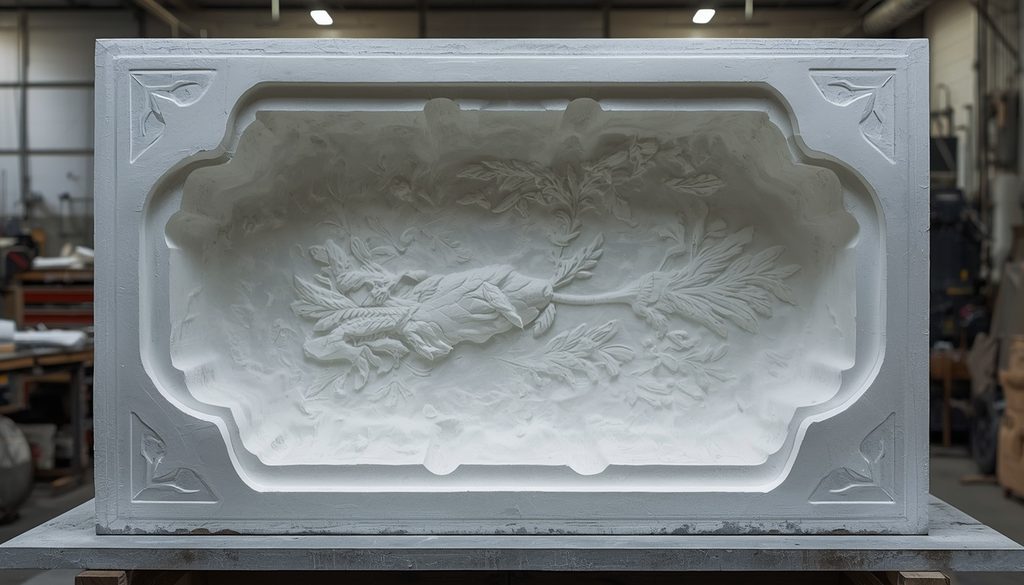
A Glass Reinforced Concrete mold has one job: to shape the concrete and then let it go without a fight. That sounds simple, but it takes the right combination of material, design, and preparation.
Durability and release properties
A mold has to survive repeated casting. Some molds are used once. Others are used hundreds of times. The material must hold up under moisture, chemicals, and handling. It also has to release the cured GFRC cleanly. If the concrete sticks, the surface tears, and the piece is ruined.
Surface finish transfer
The mold surface becomes the GFRC surface. Every scratch, dust particle, and imperfection in the mold shows up in the final product. A smooth mold gives a smooth panel. A textured mold gives a textured panel. That is why mold surfaces are polished, sealed, and cared for like a finished product themselves.
Dimensional accuracy
GFRC panels and elements often have to fit together on site. If the mold is warped or out of tolerance, the pieces will not align. Edges will not meet. Joints will be uneven. A good mold holds its shape through casting, curing, and release.
Ease of use
A mold that is hard to fill, hard to release, or hard to clean slows down production. Good molds are designed with the production process in mind. They have proper draft angles, smooth transitions, and accessible edges. They work with the casting method, whether that is spray-up or premix.
Mold Materials for GFRC
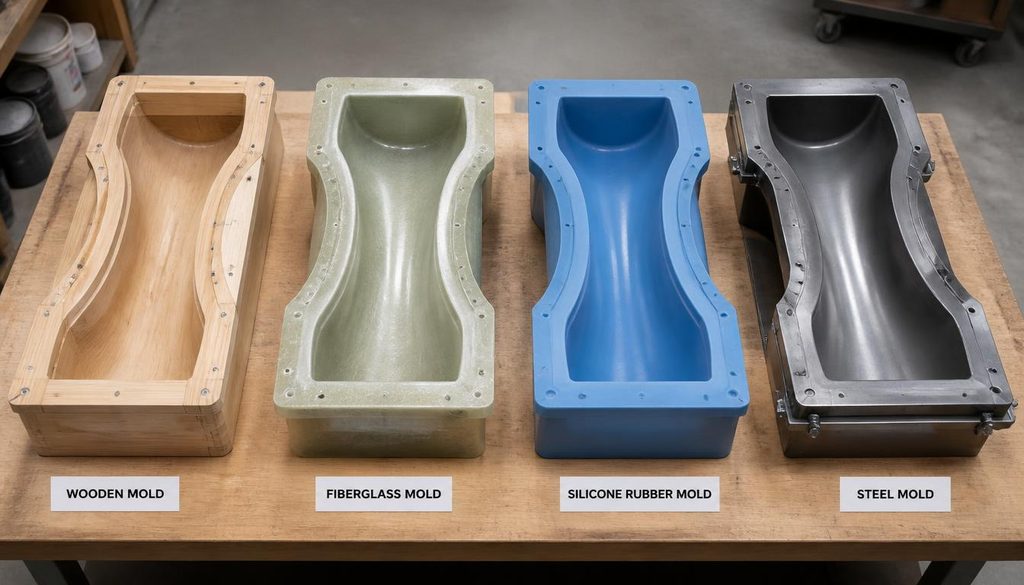
The material you choose for a Glass Reinforced Concrete mold depends on how many castings you need, how complex the shape is, and how much you want to spend. There is no single best material. Each one has a job it does well.
Wood and plywood
Wood is the cheapest and most common material for one-off molds and prototypes. It is easy to cut, shape, and assemble. Plywood and MDF work well for flat panels and simple forms. The downside is durability. Wood swells when it gets wet, so it needs sealing before casting. It also wears out quickly. A wooden mold may only survive a handful of castings before the surface breaks down.
Fiberglass and FRP molds
Fiberglass molds are the standard for production work. They are made by laminating fiberglass and resin over a master pattern. The result is a strong, lightweight mold that holds fine detail and releases cleanly. Fiberglass molds can last for hundreds of castings if they are cared for properly. They are ideal for complex shapes, curved panels, and any project that needs repeatable results.
Rubber and silicone molds
Rubber and silicone molds are flexible. They are used for pieces with undercuts, deep relief, or intricate details that rigid molds cannot release. The rubber flexes to let the cured GFRC out without breaking the edges. Silicone gives the best surface detail and release. The trade-off is cost and limited lifespan. These molds are usually backed with a rigid mother mold to hold their shape.
Steel and aluminum molds
Metal molds are the most durable option. They hold tight tolerances, resist wear, and last for thousands of castings. They are used in factory production where the same piece is made over and over. The downside is cost and weight. Metal molds are expensive to make and heavy to handle. They are rarely used for custom or small-run work.
MDF and coated board
MDF is a step up from raw wood. It has a smooth, uniform surface that takes sealers well. Coated boards and laminates can be used directly as mold surfaces for flat panels. They are cheap, easy to work with, and give a good finish. Like wood, they wear out after repeated use.
The choice comes down to this: wood and MDF for one-offs and prototypes, fiberglass for production runs, rubber and silicone for complex shapes, and metal for high-volume factory work.
Mold Types: Which One to Use
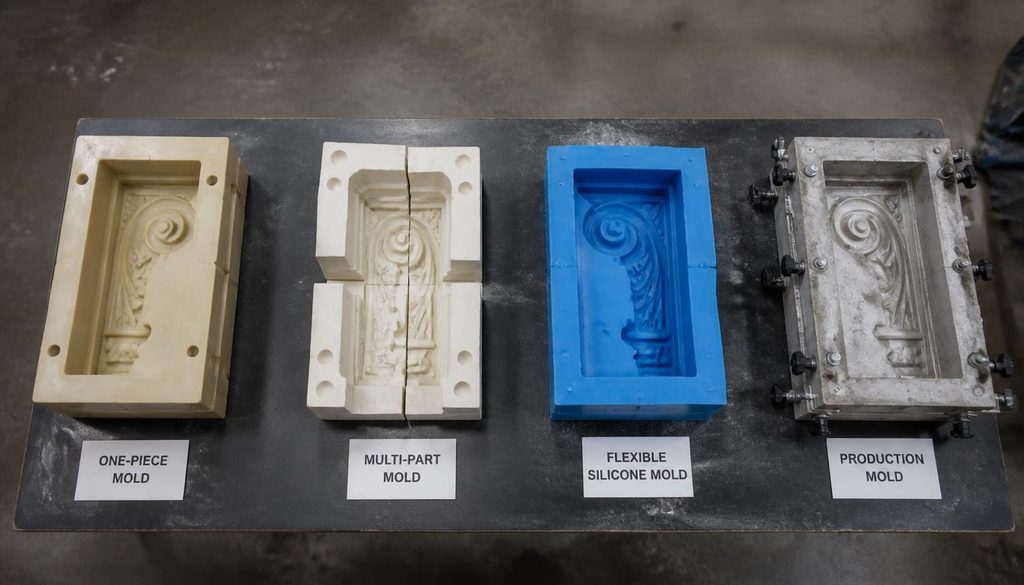
Molds come in different shapes and configurations depending on the piece and the production method. The four main types cover almost every Glass Reinforced Concrete project.
One-piece molds
A one-piece mold is a single, continuous form. The GFRC is cast into it and released as one piece. These molds work best for simple shapes with no undercuts—flat panels, tiles, simple planters, and basic decorative elements. They are cheaper to make and easier to use. The limitation is shape. If the piece has deep undercuts or complex geometry, a one-piece mold will not release it.
Multi-part molds
When a shape has undercuts or complex geometry, the mold is split into two or more parts. Each part is removed separately after casting. This allows the GFRC to come out without forcing or breaking. Multi-part molds are common for columns, curved benches, and sculptural pieces. They cost more and take longer to assemble, but they make shapes possible that a one-piece mold cannot handle.
Flexible molds for complex shapes
Rubber and silicone molds are flexible by nature. They stretch over undercuts and deep relief during release. These molds are often backed with a rigid mother mold that holds the shape during casting. Once the mother mold is removed, the flexible mold peels away from the GFRC. This is the standard approach for decorative panels with fine detail, natural stone textures, and intricate ornamental work.
Production molds vs. one-off molds
A one-off mold is built for a single casting. It may be made from wood, foam, or MDF. It does not need to survive repeated use. A production mold is built to last. It is made from fiberglass, rubber, or metal and is designed for many cycles. The choice depends on how many identical pieces the project needs. One panel: one-off mold. Five hundred panels: production mold.
The wrong mold type causes sticking, breakage, and wasted material. The right one makes casting smooth and repeatable.
How a GFRC Mold Is Built
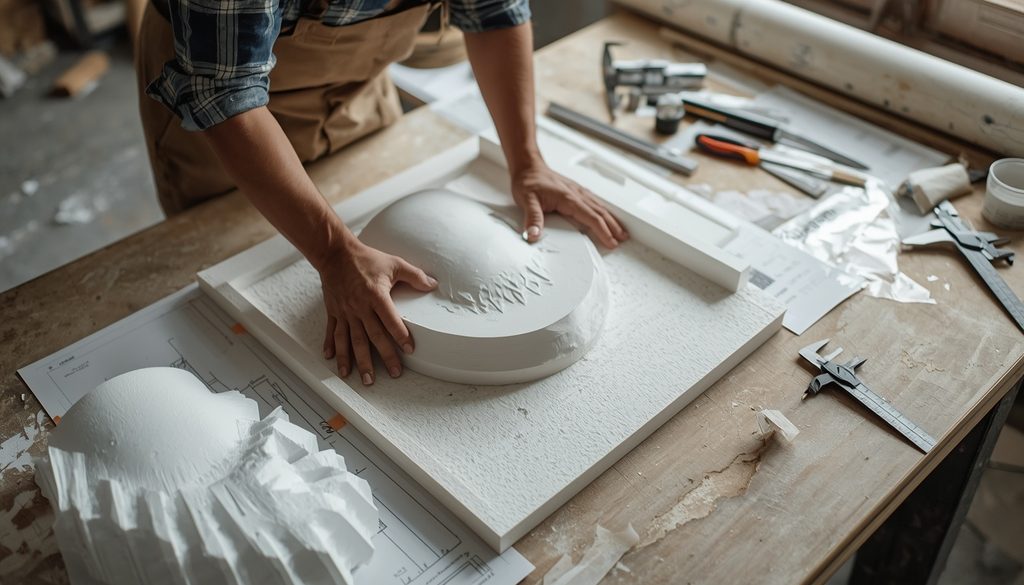
Building a Glass Reinforced Concrete mold is not complicated, but it has to be done in the right order. Skip a step and the mold will not release cleanly, or the surface will be full of defects.
Design and pattern making
Everything starts with the design. The shape, size, texture, and undercuts are all decided here. From the design, a pattern is made. The pattern is a full-size model of the final piece, usually made from wood, foam, MDF, or clay. It has to be accurate because the mold copies it exactly.
Building the master
The pattern is finished and sealed. Any imperfections on the pattern become imperfections in the mold and then in the GFRC. Once the pattern is ready, it is mounted on a base and prepared for mold making. Edges are sealed. Release agent is applied.
Creating the production mold
For a fiberglass mold, resin and fiberglass mat are layered over the pattern. Each layer is built up until the mold is thick enough to hold its shape. For a rubber mold, liquid silicone or rubber is poured or brushed over the pattern. Once cured, a rigid mother mold is built around it to support the flexible inner mold.
Surface preparation and release agents
After the mold is cured and removed from the pattern, the inner surface is cleaned and inspected. Any defects are repaired. Then a release agent is applied. Some molds use wax. Some use PVA film. Some use semi-permanent release coatings. The release agent decides how cleanly the GFRC comes out.
Once the mold is built and prepared, it is ready for casting. The quality of the mold surface determines the quality of every piece that comes out of it.
Release Agents and Surface Treatment
A mold that will not release is useless. The release agent is what makes the difference between a clean surface and a torn one. It sits between the mold and the Glass Reinforced Concrete, stopping them from bonding together.
There are three main types of release agents used in GFRC mold making.
Wax-based release agents
Wax is the traditional choice. It is applied in thin layers, buffed, and sometimes applied multiple times. Wax gives a good surface finish and works well with fiberglass and metal molds. The downside is buildup. Wax residue accumulates on the mold over time and needs to be stripped off before the surface starts to dull. Wax also leaves a slight film that can interfere with gel coats and some paints.
PVA release films
PVA is a water-soluble film that is sprayed or brushed over the mold surface. It dries into a thin plastic layer. The GFRC cures against the PVA, and the PVA washes off the finished piece with water. PVA gives a very clean release and works well with epoxy and polyester resins. It is less common with GFRC because the concrete can absorb some of the PVA film, but it is still used in specific applications.
Semi-permanent release coatings
These are the modern standard for production molds. They are applied in multiple thin coats, cure chemically, and bond to the mold surface. Each application can last for several castings before reapplication is needed. Semi-permanent coatings give the cleanest release, the best surface finish, and the longest mold life. They cost more upfront but save time and labor over a production run.
Common mistakes
The biggest mistake is applying too much release agent. A thick layer causes surface defects, fish eyes, and uneven texture. The second mistake is applying too little or missing spots. That causes sticking and tearing. The third is using the wrong release agent for the mold material. Wax on a silicone mold does nothing useful. PVA on a sealed wood mold can soak in and fail.
Release agents are not a place to cut corners. The cost is small compared to the cost of a ruined casting.

Emma Clarke is an architect with a background in building materials and facade engineering. She has worked on GRC projects in various climates and specializes in material performance and restoration.