

Glass reinforced concrete production generates substantial dust during panel fabrication. Cutting, grinding, and finishing operations release fine particles into workshop air. These particles settle on floors, accumulate in extraction systems, and ultimately reach waste streams. Most GRC manufacturers treat this dust as ordinary industrial refuse destined for landfills. The material composition tells a different story.
The dust contains unhydrated cement particles, glass fibers, and aggregates identical to those in the finished GRC panels. Its chemical profile matches the parent material. Those particles retain cementitious potential. That potential remains unrealized when the dust goes to disposal sites. The concept of dustcrete emerges from recognizing this missed opportunity.
Cement production accounts for roughly eight percent of global carbon dioxide emissions. The industry has pursued supplementary cementitious materials for decades. Fly ash, ground granulated blast furnace slag, and silica fume already replace portions of Portland cement in concrete mixes. Dustcrete extends this logic to the GRC manufacturing facility itself. The waste stream becomes a resource stream.
What Dustcrete Actually Contains
GRC production dust differs from general construction debris. The composition reflects the GRC mix design. The dust includes ordinary Portland cement, fine aggregates, and alkaline-resistant glass fibers. The particles are smaller than standard cement grains. Their fineness accelerates pozzolanic reactions when properly activated.
Ceramic powder, a similar waste material from tile manufacturing, has demonstrated promising results in GRC mixtures. Studies on ceramic powder as a supplementary cementing material show that replacement levels of ten to twenty-five percent by weight maintain mechanical properties. The ceramic particles reduce calcium hydroxide content in the cement matrix. This reduction protects glass fibers from alkaline attack. The microstructure becomes denser and more durable.
Dustcrete operates on parallel mechanisms. The finely ground dust particles fill microscopic voids in the cement paste. This packing effect increases density and reduces permeability. The glass fiber fragments embedded in the dust provide additional reinforcement within the matrix. The cement particles in the dust hydrate and contribute to the overall strength development.
Performance Properties and Testing
Research on ceramic powder in GRC has established performance benchmarks. Concrete containing ceramic waste maintained workability and flexural strength over 180 days of testing. The positive effects extended to resistance against sulfate attacks and freeze-thaw cycling. Absorption rates decreased alongside porosity reductions.
Microstructural analysis revealed improved fiber durability when ceramic particles replaced cement. Images from electron microscopy showed reduced fiber degradation after exposure to aggressive environments. Hot water immersion testing and wet-dry cycling confirmed the material’s enhanced durability. X-Ray Diffraction results confirmed reduced portlandite content, the compound responsible for fiber corrosion. These findings apply directly to dustcrete formulations.
Dustcrete benefits from similar mechanisms. The high fineness of production dust promotes rapid pozzolanic reactions. Calcium hydroxide from cement hydration reacts with silica in the dust to form additional cementitious gel. This gel strengthens the matrix and reduces permeability. The glass fiber fragments provide micro-reinforcement that controls cracking.
Manufacturing and Processing Methods
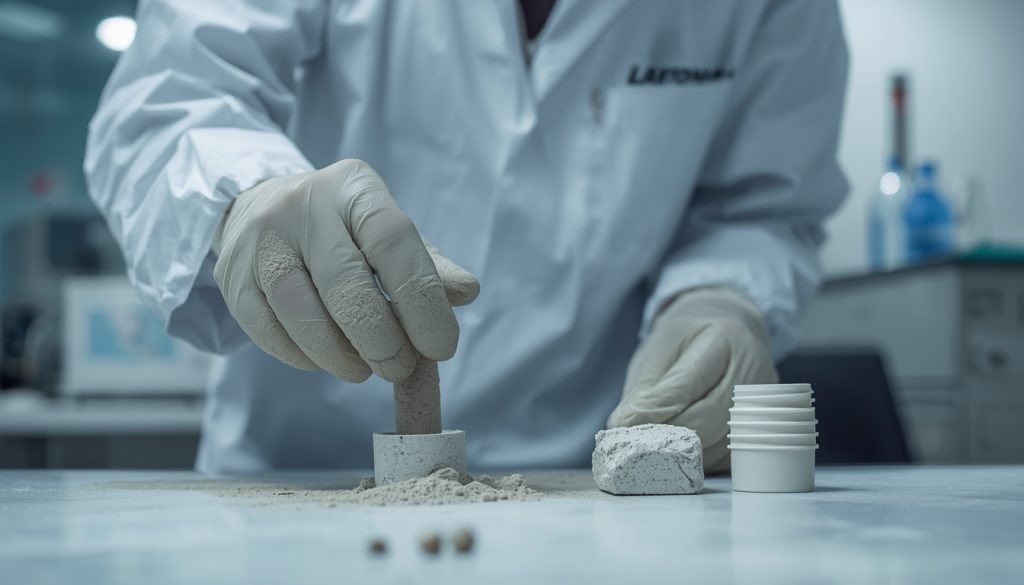
Implementing dustcrete requires changes to GRC production workflows. Dust collection systems must separate and store material for reuse rather than disposal. Baghouse filters and cyclone separators capture particles of varying sizes. The captured material requires screening to remove larger debris before incorporation into fresh mixes.
Processing steps determine the dust’s effectiveness. The material must achieve consistent fineness for predictable performance. Milling may be necessary for coarse particles. Blending with fresh cement in controlled proportions ensures batch-to-batch consistency. Quality control testing verifies that the recycled material meets specifications before it enters new production.
Economic Arguments for Dustcrete Adoption
The financial case for dustcrete rests on multiple factors. Cement constitutes a significant portion of GRC production costs. Replacing ten to twenty-five percent of that cement with recovered dust reduces raw material expenditure. The savings accumulate across production volumes. A medium-scale GRC facility generating several tons of dust monthly could see substantial annual reductions in material costs.
Disposal expenses add to the economic burden. Landfill fees, transportation costs, and handling charges accompany dust disposal. Eliminating or reducing these waste streams yields immediate savings. The equipment investment required for dust collection and processing pays back through avoided disposal costs and reduced cement purchases. The economics improve as cement prices rise and landfill fees increase.
Local availability of raw materials affects the financial equation. Facilities in regions with high cement import costs benefit more from dustcrete adoption. The closed-loop nature of the material flow reduces external dependencies. Production becomes less vulnerable to supply chain disruptions affecting cement deliveries.
Environmental Impact and Carbon Reduction
The environmental benefits of dustcrete extend beyond waste reduction. Every kilogram of cement replaced by recovered dust prevents approximately 0.9 kilograms of carbon dioxide emissions. A facility producing one thousand tons of GRC panels annually could potentially reduce its carbon footprint by several tons through dustcrete implementation.
The material also reduces the demand for virgin raw materials. Quarrying for aggregates and mining for cement raw materials have environmental consequences. Dustcrete reduces those impacts through increased material efficiency. The circular economy principle applies directly: waste from one process becomes feedstock for the same process.
Landfill diversion represents another environmental benefit. GRC production dust occupies space in disposal sites and may contain substances of environmental concern. Keeping the material within the production cycle eliminates those disposal impacts. The longevity of GRC structures means the embodied carbon benefits persist over decades of building service life.
Challenges and Constraints
Dustcrete implementation faces obstacles. The variability of dust composition presents a quality control challenge. Different production runs produce dust with varying particle sizes and compositions. Consistent processing and blending protocols must address this variability to ensure reliable performance.
The presence of glass fiber fragments in the dust influences workability. Excessively fine particles can increase water demand. Adjustments to mix water content or superplasticizer dosage may be necessary. The proportion of dust that can replace cement without compromising performance requires determination through testing specific to each facility’s dust characteristics.
Equipment investments may deter smaller manufacturers. Dedicated dust collection systems and processing equipment represent capital expenditures. The payback period depends on production volumes and local material costs. Facilities lacking existing dust extraction systems face higher implementation barriers.
Practical Implementation Strategies
Phased implementation reduces risks associated with dustcrete adoption. Initial trials with low replacement levels, such as five percent, allow evaluation of performance before increasing proportions. Small-scale testing of mechanical properties provides confidence before full production runs. Gradual scale-up minimizes potential disruptions to production schedules.
Quality assurance protocols are essential for successful implementation. Regular sampling and testing of dust composition ensures consistency. Sieve analysis determines particle size distributions. Loss on ignition testing measures organic content that could affect hydration. Chemical analysis confirms oxide composition matches expected values. These tests enable adjustments to processing methods as needed.
Integration with existing quality management systems streamlines adoption. ISO 9001-certified facilities can incorporate dustcrete into their documented procedures. Standard operating procedures for dust collection, processing, and batching reduce variation. Worker training ensures proper execution of the new processes.
Future Research Directions
Further investigation into dustcrete performance would strengthen the case for widespread adoption. Long-term durability studies beyond 180 days would confirm the material’s service life. Testing under various exposure conditions, including marine and industrial environments, would establish application limits. Characterization of the pozzolanic reactivity of dust from different GRC formulations would optimize replacement levels.
Comparative studies between dustcrete and other supplementary cementitious materials would guide material selection. Understanding the interactions between dust particles and superplasticizers would improve mix design. The potential for dustcrete in applications beyond GRC production, such as precast concrete, warrants exploration.
Industry Adoption Potential
The construction industry’s trajectory toward lower-carbon materials favors dustcrete adoption. Regulatory pressure and client demand increasingly favor sustainable practices. GRC manufacturers seeking environmental certifications could incorporate dustcrete into their sustainability credentials. The material aligns with circular economy principles that many stakeholders now require.
Market differentiation provides additional incentive. Manufacturers offering reduced-carbon GRC products could command premium pricing in sustainability-focused markets. Early adopters gain experience and optimize processes before competitors. The technical knowledge accumulated through implementation becomes a competitive advantage.
The scalability of dustcrete depends on industry collaboration. Sharing of best practices among GRC manufacturers accelerates learning. Industry associations could develop guidelines for dust collection and processing. Standardized test methods would enable performance comparison across facilities.
Conclusion
Dustcrete represents a practical application of waste valorization within the GRC manufacturing sector. The material transforms an environmental liability into an economic asset. The technical feasibility has been demonstrated through analogous ceramic powder research. The economic case rests on cement replacement and disposal avoidance. The environmental benefits include carbon reduction and landfill diversion.
Implementation challenges exist but are manageable through phased approaches and quality control. The construction industry’s sustainability momentum favors adoption. GRC manufacturers positioned to implement dustcrete gain environmental credentials and cost advantages. The material embodies the circular economy principle where waste becomes resource at the factory gate.

Emma Clarke is an architect with a background in building materials and facade engineering. She has worked on GRC projects in various climates and specializes in material performance and restoration.